|
Neil Peart's Drum Kits
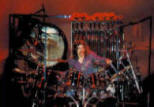
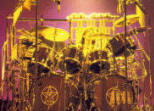
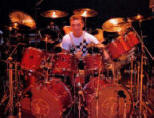
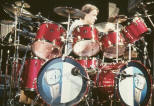
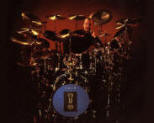
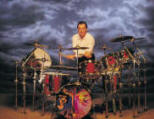
 Neil Peart's drum kit always inspires drummers'
(and
non-drummers') imaginations. I always think of the first time I saw
Rush in 1984 on the Grace Under Pressure
tour. Before the show, a red curtain covered the entire kit. Then, right
before the house lights went down, Neil peeked out from behind the curtain like
the Wizard of Oz. The lights went out, the curtain came off, and
the band took to the stage. After
the show, people lined up against the front of the stage to get a look at the
Tama Artstar prototype as the crew packed it away into cases. It was like looking at a Ferrari.
Same color, too.
If you've wondered why Neil has such a large drum
kit, it's actually pretty simple: He uses all those drums the same way a piano player uses all the keys;
it simply adds more melody to his playing. In a power trio like Rush, Neil wants
to be able to fill those musical holes in interesting ways.
On this page, you'll find all the drum kits Neil
has played throughout his life. Where possible, I've included tour book
introductions by Neil about the drum kit. Anything in quotes was written
by Neil. You can click most of the images for a larger picture.
Now, take a tour of Neil Peart's drum kits...
Drum Channel Master Class Kit New!
Buddy Rich 2008
kit
Snakes & Arrows kit
West Coast Recording Kit (2006/2007)
Before Rush
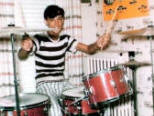
Neil's first drum kit: Stewarts
"It was a three piece, red sparkle Stewart outfit (I
still remember it cost $150), bass drum, snare drum, and tom-tom, with one small
cymbal. It was one of those unbearably exciting days in life, waiting for them
to arrive, then setting them up in the front room and playing and playing the
only two songs I knew, 'Land of a Thousand Dances'... and 'Wipeout.'" (from
Traveling Music, page 69)
"The Drums? Well, they're Stewarts, of course,
with an 18" Capri bass drum I got in a trade from my friend, and featuring the
finest Ajax cymbals from Japan. (As my colleague Lerxst pointed out, those were
the days when "Made In Japan" really meant something―none of your quality
materials and meticulous workmanship then, boy.)" (from the Test for Echo
tour book).
Neil's second drum kit: Rogers
"A set of Rogers drums, in a gray ripple finish They
were so beautiful, but they cost a fortune: $750."
(from Traveling Music, page 71).

Neil's third drum kit (playing with J.R. Flood,
1970): Rogers (corrected on 6/28/08).

Back to Top
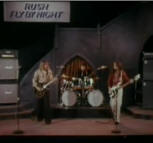
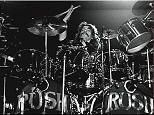
Fly By Night - 2112
Drum
information corrected on 3/29/09 - thanks to David Duran for providing
additional information
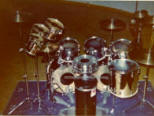
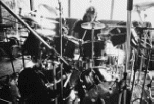
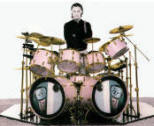
Drums: 1974 Slingerland in Chrome finish, with
combinations of 6", 8", 10" and 12" concert toms, two 9"x13", 15", and 18",
tom-toms, two 14x22" bass drums, and a 5" x 14" wooden snare drum.
Cymbals: Avedis Zildjian, including a 6" and 8"
splash, two 16", one 18", and one 20" crash cymbals, a 22" ride, an 18" pang,
and a pair of 13" hi-hats.
Percussion: Cowbells, wind chimes, concert bells
(glockenspiel).
Hardware: Various Slingerland, Rogers stands, and
Ludwig stands. Ludwig Speed King bass drum pedals.
Sticks: Pro-Mark 747 (butt end)
Picture of Neil's 1975
kit. Note the addition of the concert tom-toms. Thanks to
NeilPeartDrumsticks.com
for the photo.

In in August, Neil
Peart's first Slingerland kit sold on eBay for $25,100.00. Here are some
photos of the kit before it was sold by Main Drag Music.
Go to the auction page.

Back to Top
A Farewell
to Kings
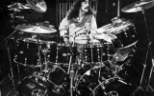
"My drums are all by Slingerland, with the shells all treated with a process
called Vibra-Fibing, which puts a thin layer of fiberglass on the inner shell.
This helps to improve the natural warmth and resonance of the drums, while it
sharpens the attack to give greater projection. The kit consists of two 24" bass
drums, 6", 8", 10" and 12" concert toms, 12", 13", 15", and 18", tom-toms, and a
5" x 14" wooden snare drum. The cymbals are all by Avedis Zildjian, a 6" and 8"
splash, two 16", one 18", and one 20" crash cymbals, a 22" ride, an 18" pang,
and a pair of 13" hi-hats.
"My collection of percussion 'toys' currently includes tubular bells,
glockenspiel, wind chimes, temple blocks, timbales, bell tree, triangles, and a
set of melodic cowbells.
"I use Remo Black Dot drum heads on my snare and bass drums, Ludwig Silver
Dots on the concert toms and timbales, and Evans Looking Glass (top), and Blue
Hydraulic (bottom) on the tom-tom. I use Promark 747 drumsticks, with the
varnish sanded off of the gripping area."
Back to Top
Hemispheres
"My drums
are all by Slingerland, with the inner surface of the wooden shells treated with
a process called Vibra-Fibing. This consists of a thin layer of glass fiber and
resin. (The drums include) two 24" bass drums, 6",8",10", and 12" concert toms, 12",
13", 15", and 18" tom-toms, and a 5"x14" wood shell snare drum. All cymbals are
by Avedis Zildjian, with the exception of an 18" Chinese cymbal. The Zildjians
are 6" and 8" splash, two 16", one 18" and one 20" crash cymbals, and 22" ride,
a pair of 13" hi-hats, and 18" pang and a 20" China type.
"In the percussion department are orchestra bells, tubular bells, wind chimes,
crotales, timbales, tympani, gong, temple blocks, bell tree, triangle, and
melodic cowbells.
"For heads I use Remo black dots on the snare and bass drums, Ludwig silver dots
on the concert toms and timbales, and Evans Looking Glass (top), and Speed King
pedals, and Tama and Pearl stands. I use Pro-Mark 747 drumsticks with the varnish
sanded off the gripping area."
Back to Top
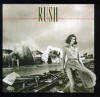
Permanent Waves
"I recently
became the proud owner of a new set of Tama drums, once again with the inner
side of the wooden shells coated with the Vibra-Fibing treatment. Along with the
custom finish and the brass-plated metal hardware, this operation was performed
by the Percussion centre of Fort Wayne, Indiana. The sizes of the drums remain
unchanged, consisting of two 24" bass drums, 6", 8", 10" and 12" concert toms,
12", 13" 15" and 18" closed toms, and a 5 1/2 x 14" wooden snare drum. I
probably need hardly (to) add that both on the road, and most especially on this
newest record, I am very pleased with the combination of the thick, wooden
shells, and the dependable, modern hardware.
"All my cymbals are still by Avedis Zildjian, with the exception of one 18"
Chinese cymbal. They are a 6" and 8" splash, two 16", one 18", and one 20" crash
cymbals, a 22" ride, a pair of 13" high-hats, an 18" pang, and a 20" China type.
"Digging into the toy box we find the usual assortment of effects, including
timbales, melodic cowbells, orchestra bells, wind chimes, tubular bells, bell
tree, tympani, temple blocks, triangle, gong, and crotales.
"On my snare and bass drums I use Remo black-dot heads, Ludwig silver-dots on
the concert toms, and Evans Looking Glass (top) and Blue Hydraulic (bottom) on
the other toms. Ludwig Speed King Pedals and Tama hardware complete the set-up.
My drumsticks are still Pro-Mark 747's with the varnish removed from the
gripping area."
Back to Top
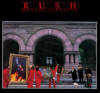
Moving Pictures
"I am still
releasing my hostilities on Tama drums, all with wooden shells, and the inner
side 'Vibra-Fibed.' The bass drums are 24", the toms are 6, 8, 10, 12" concerts,
and 12, 13, 15, and 18" closed toms. I am still using my 'old faithful'
wood-shell snare, a 5 1/2 x 14 Slingerland, and have recently made a switch to
wooden timbales, and retired my tympani and gong in favor of a pair of Tama
'gong bass drums,' which are open-ended bass drums on a stand, utilizing
oversize heads to give a very deep, resonant sound.
"My cymbals are Avedis Zildjians, with the exception of one genuine Chinese
China type. The Zildjians are 8" and 10" splash, 13" high-hats, two 16", and one
each 18" and 20" crash cymbals, a 22" ride, an 18" pang, and a 20" China type.
"In the Percussion Department are orchestra bells, tubular bells, wind chimes,
temple blocks, cowbells, triangles, bell tree, crotales, and Burma bell.
"I use Remo clear dots on my snare and bass drums, Ludwig silver dots on the
concert toms, and Evans Looking Glass (top), and Blue Hydraulic (bottom) on the
closed toms. Clear Remos are used on the timbales and gong bass drums. Ludwig
pedals, Slingerland hi-hat, Tama hardware, and Pro-Mark 747 drumsticks are the
final details."
Back to Top
Signals
"Well, well!
Hello again for another tour! (This is getting to be habit forming!) I've got
some new drums to tell you about. Once again, they are Tamas; with the custom
candy-apple red finish, the brass plated hardware, and the Vibra-Fibing of the
inner shells performed by the Percussion Center of Fort Wayne. The sizes remain
the same: two 24" bass drums, 6", 8", 10", and 12" concert toms, 12", 13", 15",
and 18" closed toms, and 20" and 22" gong bass drums. My snare is still the same
old wood-shell Slingerland, and I am using the Tama wooden timbales with great
satisfaction.
"With the exception of the trashy Chinese cymbal, all my cymbals are by Avedis
Zildjian. They are: 8" and 10" splash, 13" High Hats, two 16" crashes, one each
18" and 20" crash, a 22" ride, an 18" Pang, and a 20" China Type.
"In the Department of Percussion Effects are orchestra bells, tubular bells,
wind chimes, temple blocks, numerous semi-melodic cowbells, triangle, bell tree,
and crotales.
"There are Remo Clear Dot heads on the snare and bass drums, Evans Heavy Duty
Rock on all the toms and the gong bass drums, and Evans Tom-Tom models on the
bottoms of the closed toms. These are all non-Hydraulic heads. I use clear Remos
on the timbales. All of the stands and hardware are by Tama, and I am still
using Promark 747 sticks, with the varnish removed from the gripping area by
Larry."
"And that's all!"
Back to Top
Grace Under Pressure
"Hi there folks! I'm the blurry blob in the middle of all
those DRUMS! I don't know where they came from, but every time I turn around
there are more of them! When they're packed away in those dark, warm cases you
don't suppose they...? (Eerie music fades up)
"'You are entering a world of imagination...'
"You are entering a world of drums ―that's what! I've got drums literally
coming and going this year. Everywhere I turn, more of 'em close in around me.
More and More of them, getting bigger and bigger ― and they're red!! Red, like
blood! "Izzen dat scaddy kids?" O-O-W-H-O-O-O-o-o-o.
"O-kay!... Ahem. The main kit remains the same, the prototype for what they're
calling the Tama Artstar these days. Two 24" bass drums, 6", 8", 10" and 12"
concert toms, 12", 13", 15" and 18" closed toms, and a 22" gong bass drum is the
basic outfit. The "Old Faithful" 5x14" Slingerland snare is still number one,
and I am again using a metal timbale, a 13" Tama to be exact.
"The cymbals are of course by Avedis Zildjian, 8" and 10" splash, 13" hi-hats,
two 16" crashes, one each 18" and 20" crash, a 22" ride (ten years old now!), an
18" pang, and a 20" China type. There is also a China type which is really from
China. (As opposed to America, Switzerland, Italy or Turkey.) On the rear kit
there are more Zildjians ― another 22" ride, 16" and 18" crash, 13" hi-hats,
and another of those Chinese jobs.
"The rear set consists of a Tama 18" bass drum, another Slingerland snare,
three Simmons tom modules and one snare module, and the Simmons "Clap Trap" with
foot switched both fore and aft.
"The incidental percussion department is also in a change of state as we
speak, but may consist of orchestra bells, wind chimes, crotales, temple blocks,
cowbells and/or a bell tree, I'm just not sure.
"I'm still using the Remo clear-dot heads on the snare(s) and bass drums,
Evans Heavy Duty Rock (top) and Evans Tom Tom (bottom) on
the closed toms, Remo
black-dots on the concert toms, and plain Remos on the timbale and gong bass
drums. All of the hardware (but for a couple of small bits) is by Tama, as are
the "Camco" chain-drive pedals, and I'm still chewing up Promark 747 sticks,
which have the varnish filed off the shoulder area by Larry. (He's the blurry
black blob in the back tearing his hair and gnashing his teeth over the drums,
the monitors, the headphones, the electronics and all of the presets for the
Simmons and the Clap Trap!)
"AH-HA-HA-HA-ha-ha!! (O-o-o-o-o...scaddy!)"
Read about where the famous Artstar Prototype is now.
Back to Top
Power Windows
"Well the big news this time is in the area of electronics. My experiments
last time in combining the Simmons electronic drums with my acoustic setup
worked out very well, and having the two separate drum sets back-to-back has
allowed me to expand the variety of sounds I can choose from without
compromising the feel and voice of natural drums.
"With the use of Simmons SDS-7 digital modules and the EPROM unit (Erasable
Programmable Read-Only Memory) I can now reproduce, for example, the African
drums which I played on "Mystic Rhythms", stored on tiny little chips and
triggered by the pads. This is a very exciting area of exploration, as you can
imagine. Without losing the excitement and energy of real drums at the heart of
my playing, I can have an infinite variety of other percussive sounds and
effects to call on at the stroke of a pad or the kick of a switch. Larry and I
have even invented a little trigger (called "Sidney") which mounts between my
front toms to give me easier access to effects. fun stuff.
"You'd be right in thinking that these machines are complicated, experimental,
and sometimes frustrating. In spite of my instinctive distrust and antipathy for
things electronic, I find myself unable to resist the limitless variety of
sounds I can create and reproduce. I didn't realize that when I first played
with a little Mattel drum synthesizer ― I'd get hooked!
"Everything else remains pretty constant, the Tama drums are the "Artstar"
prototypes, except for the snares which are the old Slingerland "Artist" model.
All the cymbals are by Avedis Zildjian, except for the Chinese ones which are
from Wuhan in China. Timbale, crotales, wind chimes, glockenspiel, temple
blocks, cowbells, "Clap Trap", and a gong bass drum round out the toy box.
"And next Christmas I'd like a train set, a mountain bike, a sailboat, new
Telemark skis, a rocket ship, a Ferrari GTO, a chemistry set, eternal life..."
Back to Top
Hold Your Fire
"Well, lots of Big News in the equipment department this year, for those of
you who are interested in such things. When I decided last year that I wanted to
get a new set of drums, I went about it in a very methodical way. This time I
wanted to be absolutely sure that I was using the best sounding
drums there were. So I went down to the Percussion Centre in Fort Wayne, and we
tried out six different makes of drums, side by side with the same heads and
tuning. The result was a new set of Ludwig drums ― the ones which sounded the
most lively and exciting. A similar "A-B" comparison confirmed the effectiveness
of the Vibrafibing treatment, and that process of a thin layer of fiberglass has
been applied to the inside of the shells.
"When Geddy saw the color I had chosen for them, he asked: "Whatever
possessed you?" Well I'm not sure about that, but it's another "hot
rod" finish like the red ones, this time a combination of white opalescent, with
a few "flip-flop" sparkles, and a little hint of pink.
"Just different, that's all.
"The hardware, which has been brass plated, is a combination of Premier, Tama
and Pearl fittings, while the cymbals are by Avedis Zildjian, with the exception
of the Chinese ones which come from Wuhan province in China. The venerable
Slingerland "Artist" snare drums remain, as do the Promark 747 drum sticks.
"Big News in the electronics department as well
― the Simmons pads now
trigger an Akai digital sampler through a Yamaha Midi Controller. This has
expanded my range of available percussion sounds enormously, allowing me to have
absolutely any sound available at the flick of a stick or the
kick of a switch. Nice. I've also added a KAT keyboard percussion unit, which
again gives me all of the keyboard percussion sounds in a neat little package.
"In the "traditional" percussion domain, there are a temple blocks, timbale,
crotales, a Tama gong bass drum, cowbells and wind chimes.
"What else was I going to say?
"I forget.
"Oh well."
Back to Top
Presto
"Don't be
fooled, these are not new drums. Nope, they're the same Ludwigs
as last time, the ones that used to be pinkish, only now
they're a dark, plummy sort of purplish color. (Beautifully done by Paintworks).
"Cymbals are all by Avedis Zildjian, except for the Chinese Wuhans, and the
brass-plated hardware is a hybrid of what-have-you: Ludwig, Tama, Pearl,
Premier, and some custom-made bits from the Percussion Center in Fort Wayne. The
gong bass drum comes from Tama, and the cowbells come from Guernsey & Holstein.
Sticks are Promark 747, and heads ― always subject to change, just like human
ones ― are some combination or other of Remo and Evans. I just keep changing my
mind ― and my heads.
"Same with snare drums. That remains an open question, but I'm sure to using
some combination of my
old reliable Slingerland, a Solid
Percussion piccolo, an old Camco, and/or a Ludwig 13" piccolo (cute little
thing).
"The electronics are triggered by d-drum pads and Shark foot pedals, driving a
Yamaha midi controller and an Akai S900 sampler. A KAT midi-marimba drives
another Akai for all the keyboard percussion parts and various effects.
"You know, I was thinking about what my drum kit would look like if I had all
the real instruments up there, rather than a box full of floppy
disks and a couple of samplers. Picture a stage which contained (in addition to
that little ol' drumset): temple blocks, orchestra bells, bell
tree, glockenspiel, marimba, various African drums (including ones like 'djembe'
that I don't even know what it looks like), three tympani, a
full symphony orchestra, a 'beeper,' a big gong, harp, synthesizer, congas,
bongos, another timbale, castanets, voice-drums (recorded drum sounds vocalized
by MOI) a big huge sheet of metal, jackhammer, wood block, claves, jingled
coins, my old red Tama drumkit, and Count Basie and his band.
"Oh sure, it would look great alright, but honestly
― where
would I put all that stuff? And where would the other two guys stand?
"Yeah, you're right; I don't need those guys anyway."
Back to Top
Roll the Bones

"On the day we began setting up for the writing stage of Roll
the Bones, I stood in the little studio and watched Larry putting my drums
together. It occurred to me that I'd been using the same basic setup for years
now, and maybe it was time for a rethink―time to make some changes, take some
chances. Just putting the drums in different places might alter my approach to
them, push me in some new directions.
"So we started moving the toms around, putting the floor tom under my left hand,
and shifting the others down one position, placing the 15" where the floor tom
used to be, the 13" where the 15: used to be, and like that. This gave me some
new rhythmic possibilities, new ways to construct fills, and even familiar
patterns would sound different.
"Also I wanted to try using a single bass drum, with two pedals ― to eliminate a
big resonating chamber (the other bass drum) which I hardly ever used. I also
decided to try a different size: 22" rather than 24".
So we did all that, and it was good…
"My first set of Ludwigs had survived five years of hard labor: recording Hold
Your Fire, Presto, and Roll the Bones, as well as two long tours which included
the recording of A Show of Hands. They'd gone from pretty-in-pink to plum-crazy,
and still sounded good, but maybe it was time to give them a rest. Time for a
new kit.
"And here it I; Ludwigs once again, in their "Blue Shadow" finish, with the
brass-plating and "Vibrafibing" coordinated by the Percussion JUSTIFY in Fort
Wayne. Other than the above-named changes, the setup remains the same; Zildjian
cymbals )but for the two Chinese Wuhans), Slingerland snare, assorted cowbells,
and Tama gong bass drum. The In the "back forty", we find the Ludwig 13" piccolo
snare, 18" bass drum, plus d-drum pads, Shark pedals, and KAT midi marimba
triggering Akai samplers. Remo heads are punished by Promark "Signature" sticks.
"And that's what 's new in the toy box ― I mean tool box!"
Back to Top
Burning for Buddy Concert and Sessions

Back to Top
Counterparts
"This photo was taken in October '92, during a Bicycle Africa tour of Mali,
Senegal, and The Gambia. Djenne is a medieval town in the inland delta of the
Niger River, not far from Timbuktu. The "Great Mosque," like the rest of Djenne,
is built of mud, and every year after the rains they have to climb up and
resurface that mud, using the exposed beams as scaffolding. The minarets are
topped with ostrich eggs, and altogether it's about as amazing a thing as this
reporter has ever seen. My friend Mendelson Joe says this photo looks like "a
retired hockey player visiting another planet." And that's about how I felt
― except for the "retired hockey player" part.
"So anyway... what's new in Drumland?
Well, not a lot really. After the big changes I made to the kit for Roll The
Bones, this time I just got a new color (Black Cherry, another one of the "hot
rod" paint jobs.) The kit was coordinated,
assembled, and "vibrafibed" (a thin layer of fiberglass on the inner shell) by
Neal Graham, Larry Allen, and XL Specialty in Fort Wayne. The drums are still
Ludwigs, and the cymbals are Zildjians (except for the two Chinese Wuhans)."

"Electronically. the aging Akai samplers are driven by d-drum pads, a KAT
midi-marimba, Shark pedals, and Sid the amazing mini-trigger, while a Dauz pad
also triggers occasional keyboard "events."
"Otherwise, I still use that
old Slingerland snare, a Remo "Legato" marching
snare, a 13" Ludwig piccolo on the back kit, Tama gong bass drum, Promark
sticks, Remo heads, LP cowbells, some wind chimes, and― probably our
most-asked-about piece of hardware―two little squirrel-cage fans to help keep
my hands dry.
"And those, despite any claims to the contrary, are my biggest fans..."
Back to Top
Test for Echo
"...Nowadays, although my drums are red sparkle once again (in the spirit of my
"starting over" drumming-wise), there are a few more of them, and they are
American-made DWs, right down to the pedals, stands, and even (shock, horror!)
the snare drum. "Old Number One," the Slingerland wood-shell snare I've used
since forever, has been retired from the field after a glorious career, and a
couple of fine DW snares have taken it's place.
"The toms are 8", 10", 12", 13", 15" (two), 16", and 18", the bass drum is a 22"
(with a pair of 18" "cannons" on the back setup), mixed in with two 13" piccolo
snares, Akai samplers driven by d-drum pads, Kat midi-marimba, and Shark pedals,
and the usual selection of cowbells and windchimes.
"The heads are Remo white-coated Ambassadors (just for a change), and the cymbals
are by Zildjian, except for one Chinese Wuhan. My sticks are the Promark 747
"Signature" model, in Japanese white oak.
"My teacher for the past couple of years has been Freddie Gruber, and I would
like to thank him for leading me down the paths of righteousness."
See how Neil's T4E drum kit is put together in this
unique series of photos.
Back to Top
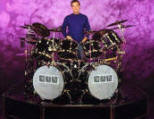
Vapor Trails

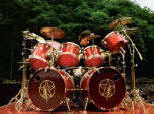
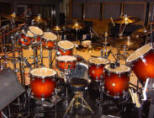
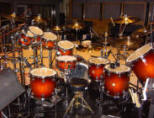
"The drums are made by DW, with a custom red sparkle finish
―
same as the last tour. (DW offered to build me a new set, but these ones still
sounded great, so I decided to keep them.)
"The bass drum is 22", the toms are 8", 10", 12", 13", 15" (two), 16", and 18".
The current favorite snare drum is a 5" x 14" DW Craviaotto, and I'm also using a
13" DW piccolo snare, miscellaneous LP cowbells, and DW pedals and hardware.
"Out back, and hidden all around, are Roland V-drums and trigger pads,
accompanying the Kat mallet controller and Shark pedals, all feeding into Roland
TD-10 modules with expansion cards, Roland 5080 sampler, line mixer, and midi
converters.
(I have no idea what any of that means.)
"Drum heads are Remo white-coated Ambassadors, and cymbals are Avedis Zildjian
―
8" splash, 2 10" splashes, 13" hi-hats, 14" X-hats, two 16" crashes, 18" crash.
20" crash, 22" ride, 20" Low China, and an 18" Chinese Wuhan.
"(That sort of thing I understand better ― you just hit them with sticks. Promark
747 "Signature" ones, in this case.)
"Someone has also written at the end of this list that I have "a really great
drum tech." That would be Lorne Wheaton, better know as "Gump." Or is that
"Grump?" Time will tell..."

Back to Top
30th Anniversary
Go to my
report on the S.S. Professor tour
for tons of details and photos of the 30th Anniversary Kit.

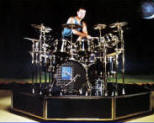
Drums:
Drum Workshop
Kick: DW 22"
Toms: 8",10",12",13",15",15",16",18"
Snares: DW 13" piccolo snare, 14" edge, 14" solid wood
Hardware: 24k gold plated DW hardware & pedals
Cymbals:
Sabian "Paragon" cymbals
Hi Hats 13",14"
Splash 8", 2x10"
Crash 2x16", 18", 20"
FX cymbals 19", 20" Chinese
Ride 22"
Electronics:
Roland V-Drums (DW shells)
Roland V-Cymbals
Roland TD-10 Brains
Fat Kat trigger pedals
Emu 4000 Samplers
Dauz trigger pad
Mallet Kat
Remo Drumheads
Pro-Mark 747 drumsticks (Oak)
Drum Tech: Lorne Wheaton
"Just about everything in my workshop is new and
different this tour―everything but the drummer, really. (And the equally
aging, but invaluable, drum tech, Lorne "Gump" Wheaton.) Even the drum riser had
to be rebuilt, after it was demolished during loadout after the Rio de Janeiro
show (fortunately the last show of the Vapor Trails tour). Upended on a flatbed
truck, the riser was being ferried to the semi-trailers outside the stadium,
when the driver failed to notice that his load was higher than the exit. Just
like in a cartoon, the whole big assembly flew off the back and went "boom."
"After that Rio show (I've been dying to tell this story somewhere), we also had
to leave behind the carpet that covered the stage (40' by 24', with the Vapor
Trails logo in the middle). It had absorbed so much rain over those three shows
in Brazil, it was too heavy to ship back to Canada. Apparently it finally dried
out, decorated a Brazilian home awhile, then appeared on eBay.
"But I digress.
"The biggest news is the cymbals. In September of 2003, I had the fascinating
experience of visiting the Sabian factory in Meductic, New Brunswick, and
working with cymbal master Mark Love on the design of my own line of cymbals,
called Paragon. The results have been extremely gratifying, first in how well
they work for me, and second in how well they've been received by other
musicians. I play a 22" ride, 20", 18", and two 16" crashes, 13" hi-hats, 14"
"x-hats," 8" and 10" splashes, and 19" and 20" China types.
"The drums are also brand, spanking new, a special "30th Anniversary" kit created
for me by the good people at DW. As we worked together on the design, we aimed
to create the drum-set equivalent of the "dream cars" displayed at auto shows, a
showpiece that was also the ultimate expression of craftsmanship. John Good
carefully selected the woods and laminates, even the grain direction, for
maximum tonality, and the shells, as always, were timbre-matched to complement ―
and compliment ― each other musically. Additional thanks to Don and Garrison for
their overview and detail work, and the finish was developed with master painter
Louie and transfer-designer Javier, partly inspired by Keith Moon's "Pictures of
Lily" kit, to represent the "dream drums" of my youth.
"The sizes are the same as the old red sparkle kit, 22" bass drum, toms 8", 10",
12", 13", two 15", 16", and 18". I have been favoring either the DW "Edge" model
snare drum (indoors) or the DW "Solid Shell" (outdoors). The hardware is plated
in 24-karat gold this time, rather than brass, and the heads are DW's own
design, which have lovely feel and resonance.
"DW also put together custom shells for the Roland V-drums, to give a nice
completion to the electronic side of the shop, which also includes a MalletKAT,
K.A.T. trigger pedals, and a Dauz pad, all running through a Roland XV5080
sampler and Project X Glyph hard drives.
"Bringing it all back to basics, and keeping it real (not to say primitive), I
continue to beat on all that with Promark signature model drumsticks."
Click thumbnail for hi-resolution images of the 30th
anniversary kit:
West Coast Recording Kit
(2006/2007)
Neil "moonlighted" on a few songs for Vertical
Horizon in 2006. Because his Rush drums were in Toronto as he worked on the new
Rush album, DW created a recording "West Coast" drum kit for Neil to do this
recording. Here are pictures and Neil's story behind the kit:
... Thus it came to pass . . . on June 14,
2006, at Capitol Records Studio B in Hollywood (Hollywood and Vine, in
fact), I recorded three songs for Matt’s upcoming Vertical Horizon album.
Even the drumset I played that day has a rich back-story, starting about two
months earlier.
While considering the logistics of getting my drums from Toronto to Los
Angeles and back, I was talking with my friends at Drum Workshop, and they
pointed out that some busy drummers have a different drumset for each coast,
stored and ready when they need it. Since I lived on the West Coast now,
maybe I should have a “West Coast kit.”
Well, yeah, obviously. So in talking to John Good at DW, we decided to build
a pure “recording” kit, with basic chrome hardware and a natural wood
finish. John designed an elaborate combination of
laminates and
reinforcement hoops for each individual shell, and
Garrison, the company’s
“artists’ rep,” started organizing the hardware. I would ship down my own
set of Paragon cymbals (properly worked-in after the R30 tour) and a few
favorite snare drums, plus a set of the “drum boards” on which my kit is
mounted, so the stands could be screwed right into it.
That was going to be helpful for another reason. My invaluable and expert
drum tech, Lorne (Gump) Wheaton, was going to be starting a tour with Steely
Dan’s great drummer, Keith Carlock, just before my sessions with Matt, so he
wouldn’t be able to be there. However, Garrison offered his assistance, and
I also called upon my friend Chris from Sabian’s Los Angeles office. Chris
had traveled with Lorne on the “S.S. Professor” tour the previous year,
demonstrating my “R30” drumset all around the U.S. and Canada, so he knew
the setup as well as anyone else apart from Lorne. Chris is a fellow
motorcyclist (Ducati Multistrada), and on June 7 he and I rode up the
Pacific Coast Highway to the Drum Workshop factory, to see how the new kit
was coming together.
Lorne and I had decided on a “tobacco sunburst” finish, like a classic
guitar, but when John chose “curly maple” for the base of it, and master
painter Louie applied his artistry, they looked way better than I had
imagined. And once I started playing them, John’s painstaking design of
their acoustic properties paid off, too — people coming in from outside the
showroom remarked on how good they sounded even from outside.
Back to Top
Snakes & Arrows

From the Snakes & Arrows
tour book by Neil Peart:
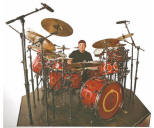
After the 30th anniversary tour, the guys at
Drum Workshop and I agreed that the R30 kit ought to be retired. I felt that
way because it had been a true centerpiece of that tour (sitting center
stage every night, after all), and I wanted to keep that "specialness." The
DW guys, lead by John Good ("the Wood Whisperer"), felt that way because
they thought they could do better.
In 2006, they built me a “West Coast
kit” on which I recorded a few songs for my friend Matt Scannell, as well as
Snakes and Arrows. Everybody who heard those drums was blown away
by their sound, but John continued to develop his ideas—combining different
combinations of laminates for the shells, like his “Vertical Low Timbre”
innovations. Just as the West Coast kit had eclipsed the R30 drums in
tonality and resonance, these new ones take it to what my teacher, Freddie
Gruber, would call “another place.” After I had rehearsed a couple of weeks
on the West Coast kit, my drum tech, Lorne “Gump” Wheaton, put up the new
ones, and I truly couldn’t believe how different they sounded—how much
bigger and warmer.
One of these drums is bigger—the 23” bass drum, which is another
unique innovation of John Good’s. Back in the 70’s, when Rush were opening
shows, I used to be able to go out front and listen to other drummers. I
noticed then that 24” bass drums had a particular “kick” (for once the word
is apt), but I preferred the playability and dynamics of a 22”. John
suspected that the 23” would combine the best of both, and he was right.
The
“VLT” approach was also applied to the snare drum’s shell, and it was
another revelation—the best I have ever played, for both response and sound.
The toms are 8”, 10”, 12”, 13”, two
15”, 16”, AND 18”, with DW’s Coated Clear heads. Remo supplies some of the
other heads, while the drumsticks are Pro-Mark signature models.
In an earlier Web story, I noted that “black is the new gold,” and this time
the hardware is plated in black nickel. Likewise, “red is the new black,”
the finish is Aztec Red, inset with a pair of logos Hugh Syme and I created
for the CD package. The Greek symbol ouroboros, or snaking eating
its tail, surrounds a calligraphic rendering of my favorite road sign: the
universal symbol for “winding road.” (On a motorcycle or in a fast car,
that’s the best kind of “snake and arrow” you can see.”) The repeating motif,
in gold leaf and metallic gray satin over the Aztec Red, was created by DW’s
master painter, Louie Garcia (a true artist).
The cymbals are my signature Paragons, by Sabian, with a 22” ride, 20”, 18”,
and two 16 crashes, 13” high-hats, 14” “x-hats,”8” and 10” splashes, 19” and
20” China types—plus our new innovation, the “Diamondback,” with tambourine
jingles.
DW once again provided custom shells for the Roland V-drums (the TD-20s),
and the electronic stuff includes a MalletKAT, KAT trigger pedals, and a
Dauz pad, all running through a Roland XV5080 sampler and Project X Glyph
hard drives.
Infographic from
Drum! Magazine, June
2007, by Rick Eberly


Pictures of Snakes &
Arrows shells before they were put through the magical DW process (left):
"...here’s a top secret spy photo of
the new drumset DW is building for me to play on the upcoming tour. It
incorporates several technical innovations developed by John Good since he
designed the tobacco sunburst recording kit I used on Snakes and Arrows
(formerly the “West Coast” kit, originally built for Matt Scannell’s
sessions early last summer). Many people have described those drums as the
“best they’ve ever heard,” but the new ones are going to be even better."
Back to Top
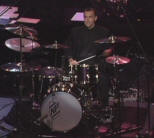
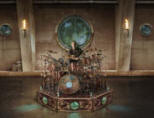
Drum Channel Master Class Kit
For many of the
demonstrations in Neil Peart's Master Class on Drum Channel, Neil uses a small
DW drum kit, similar to the Buddy Rich kit. The finish appears to be champagne
sparkle. Note that the kit doesn't include a left floor tom. Neil says at the
beginning of this segment (Lesson 9) that this is a brand new set of drums that
he's never played before.
"We thought it might be
profitable to demonstrate a few things on a small set-up. And since my big
set-up is on its way back to Canada for band rehearsals next week, it seemed
like a good idea to spend this day just working around a smaller setup and
illustrating some of the concepts. Because sometimes the big kit with the drums
and everything can either be intimidating or, I think, distracting, where
another drummer might look at it and think, 'Oh you need all that to do
everything he's doing.' Of course for any drummer, the bass drum, snare drum,
toms, cymbals, that's really all you need -- and what it's all built upon, the
foundation of drumset playing. And the rest of it's just for color and fun."


"Old
Faithful" Wooden Snare Drum - AKA "Number One"
This
Slingerland 5x14 drum was used on Rush records from nearly the beginning (I've
never heard an exact date) through Counterparts. Neil replaced it as his "number
one" snare drum during the Test for Echo tour.
This interview with Neil Peart in Modern
Drummer (April 1984) tells part of the story of this drum:
Scott K. Fish (SF): Are you still using
your Slingerland wood snare with the Artstar drums?
Neil Peart (NP): Yeah. It's
ironic, because it's not even the top-of-the-line Slingerland. It's their
second one down. I don't know what it's called. I bought it secondhand for
$60.00.
It was the first wooden snare I ever owned. I'd always used metal ones before
that and had never been totally satisfied. Then we picked up this wooden snare
and it was perfect. It was the one. Then I thought, "Well, if this isn't even
the top-of-the-line wooden one, I must be able to get something better." So I
got the top-of-the-line
wooden Slingerland, and I've tried several of the wooden Tama ones. I even have
the twin to that $60.00 snare behind me for the other kit. Everything's
identical, but it just doesn't sound the same.
I think somebody who had this snare before me did a modification on the bearing
edge of the snare side. Someone filed the bearing edge where the snares go
across. It's murder on snare heads because it makes the tension very uneven, but
the snare never chokes. I can play it however delicately or however hard, and it
will never choke.
SF: Have you ever had Tama try to
duplicate that drum?
NP: No. Basically I've just tried what Tama makes. They either sound good
loud or they sound good soft. None of them have the versatility that my snare
has. I haven't pursued it that much because my snare makes me happy as it is.
I'm not looking for something better, really.
SF: Is the inside of the snare Vibrafibed?
NP: No. I've never fooled around with it. I was even afraid to get it
painted. For a long time it was copper colored. When I had the black drums or
even when I had the rosewood Tamas, it didn't matter so much. It looked okay.
When I got the red drums, the copper started to look a bit tacky, but I was even
afraid to get it painted because disassembling it, painting it, and putting it
back together might have affected it. I think Slingerland probably still makes
that snare. I still have one of their top wooden snares too. It's good. I have a
Gretsch wooden snare, and it's also a good wooden snare.
Back to Top
|